There were two distinct takeaways from that first lesson:
best decision ever!
had I been transported to another dimension?
Yes, transported to another dimension! No I didn’t fall off and hit my head, but I certainly questioned what was being said.
Since those youthful days, where knowing the basic terms for horses and equipment: withers, saddle, girth, bridle, blah, blah, blah, nothing prepared me for the barrage of terms I was to face on this journey. I was speaking English and everyone else was engaging in fluent horse. Not the Mr Ed fluent horse either.
So let’s start from the beginning (not alphabetically) of the lesson.
Mounting
Terminology
EquestrianDefinition
My understanding
Mounting
Act of getting onto the horse’s back, usually from the left side.
Okay, not an alien term, but had never used a mounting block. A tree stump or two when available.
Reins
Terminology
EquestrianDefinition
My understanding
“How are you holding your reins?”
Thread the reins between your little and ring fingers. Keep a flat palm. Rest your thumb gently on top. Thread them between your little and ring fingers, keeping a flat palm, with your thumb resting gently on top.
What the…l Now that was news to me. “Hold reins in fists!” That’s as far as dad got with his instructions. Served me well over the years.
If memory serves me correctly, I was a little heavy handed at times. Sorry Mr Beezley!
A balanced, upright posture with an imaginary straight line from your ear, shoulder, hip to heel. The seating position in the saddle connects you to your horse’s body. It creates a conversation between the rider and the horse. ‘Jess Morrisonhttps://bit.ly/4qEE64Y“
From my perspective, as long as I remained in contact with that saddle, I was a happy rider.
This attitude will not get me far in the world of dressage though.
Steering
Terminology
EquestrianDefinition
My understanding
Steering the horse
Steering a horse under saddle is a core skill that develops connection, control and confidence between horse and rider.
Through coordinated use of the seat, leg and rein aids, the rider can guide the horse with balance and precision.
I believed I had this under control, but alas, I couldn’t have been further from the truth.
Neck reins! Yep, that’s all my steering knowledge.
My interpretation of this method was: a) lay the reins against the horse’s neck b) apply pressure to instigate turn c) right turn pressure on the left side of neck d) left turn pressure on right side of neck.
Definitely not the coordinated approach the coach was talking about.
It was another world of language and I needed to understand the terminology ASAP. Every sport, profession, group and family have their own unique terms.
Get the JARGON RIGHT—unless you’re actively trying to make friends with paramedics, doctors and perhaps an ethereal being.
Fully prepped and chomping on the bit of life, I traversed north west Brisbane to reach Wattle Creek Equestrian Centre. Everything was aflutter! Actually, mainly the butterflies in the stomach. BREATHE! BREATHE! BREATHE!
Remember, it had been 40 odd years.
Parked car! Grabbed helmet and donned boots! Off to the office to check-in, for what was to become a life changing experience.
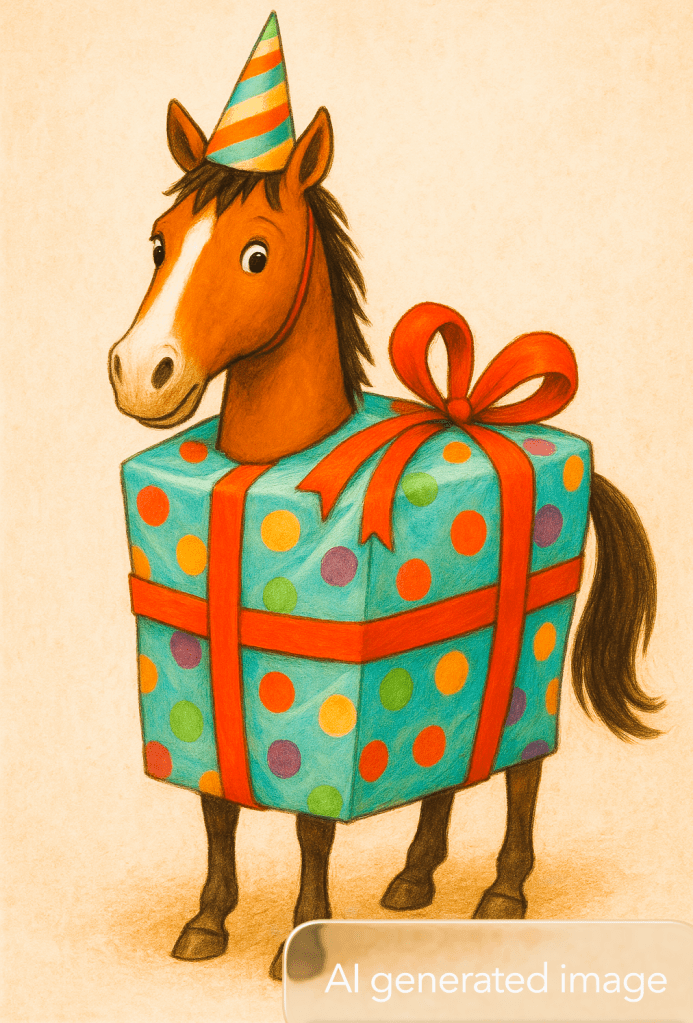
Soooo, not wrapped like this
Love at first sight
HO! HUM! A new student
Introductions with Coach Claudia and all was set. Now for the moment that had kept me awake for most of the night, meeting THE HORSE.
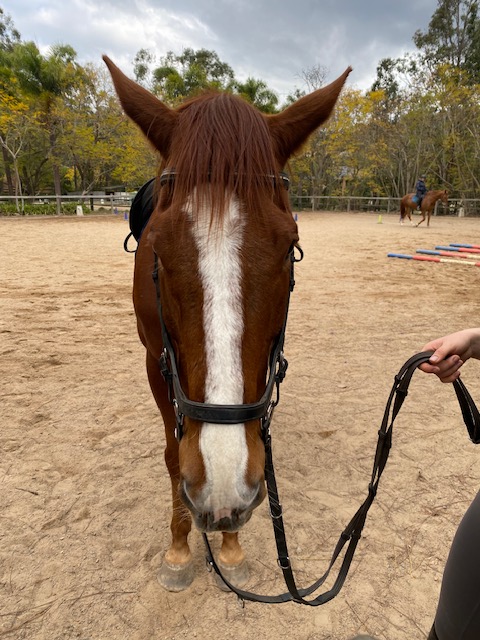
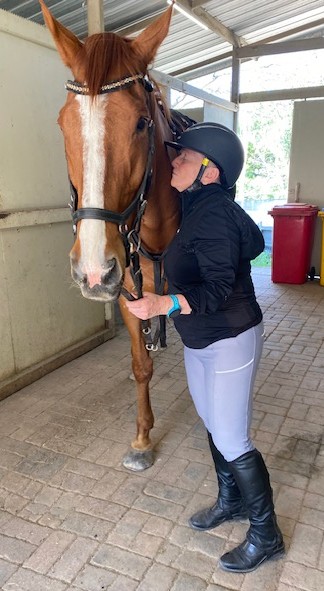
Okay, he wasn’t wrapped as a gift, but it was love at first sight. Mine that is! Tino (Mr Perfect) was some what ambivalent about the whole proceedings. Regardless, it was my time to unleash the inner equestrian.
Interesting Fact (Before we get to the inner equestrian.)
Horses’ electromagnetic spectrum
“The Heart Math Institute claims that scientific evidence conducted by Dr. Ann Baldwin and Dr. Ellen Gehrke indicates that horses can sense, and respond in kind, to the emotional state of humans – not only when we are afraid, but also when we are feeling positive emotions such as appreciation.
Apparently, they do so with an electromagnetic field, much larger than our own, projected by their heart which surrounds and influences our own heart rhythms in a positive way. Further, horses are said to possess a coherent heart rhythm (indicative of a calm state of well-being) which can further impact our mental state and explains why horses make us feel good.” (Henderson, A.Z.J. (2024, February, 8). Can horses affect our hearts. Horse Sport Magazine. https://bit.ly/3Ml3pdA
This video gives a simple explanation of this phenomena. Click twice to play.
Butterflies! Adrenalin! Heart electromagnetic field! Tino was bombarded like a New Years’ Eve fireworks display from Sydney Harbour Bridge. All was not lost, as Coach Claudia calmly (actually serenely) took me through the stirrup measuring and mounting process.
Let’s get this lesson rolling
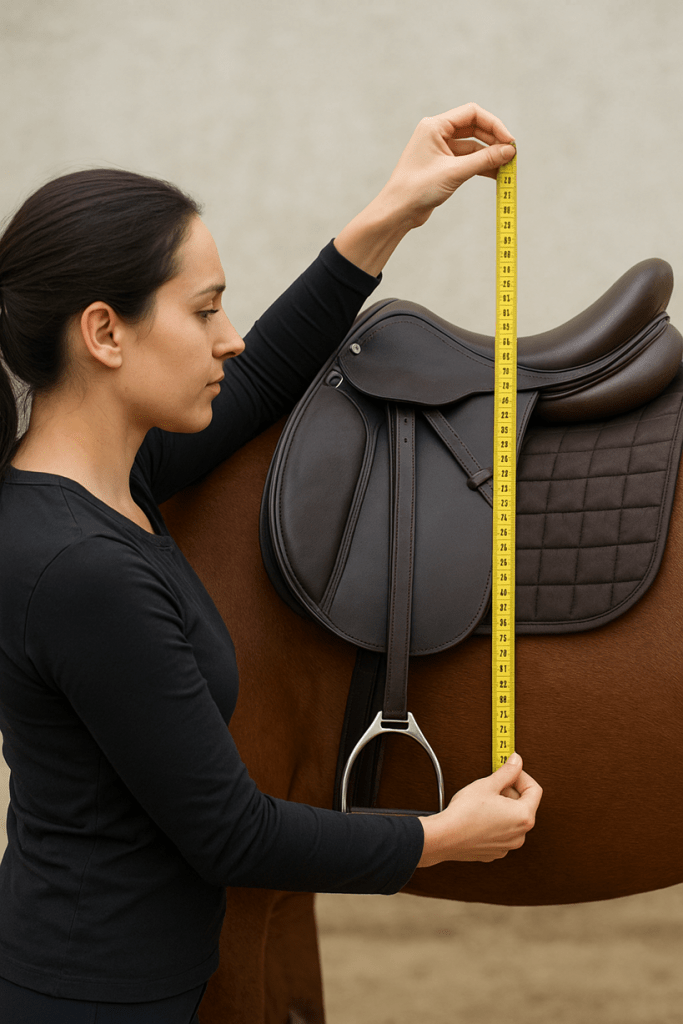
Hang on! What’s this about stirrup measuring?
Tape measure? Not in the coach’s or my pockets. Disaster before I even mount.
Coach Claudia assured me there is another approach that gives a good estimation for your stirrup length. Place your fingertips on the top of the stirrup. Hold the stirrup tread (plate where boot goes) under your armpit.
If tread doesn’t reach your armpit, the stirrup leather is too short. Stirrup leather sags, it is too long.
Why does this method provide a good estimate? It’s a matter of relationships. The average distance from a person’s fingertips to their armpit is similar to the typical distance from a rider’s hip to the stirrup.
This symmetry is present when seated.
So it’s a simple anatomical approximation that gets riders close enough for safe mounting.
Now for the mounting
A ‘praise be‘ moment for these stiff older joints and not so supple muscle – A MOUNTING BLOCK. Never used one before this lesson, now, it is the only way to mount.
Why? Again with the questions! Besides the obvious age factors, stiff and limited muscle elasticity, the horse is a major consideration in this task.
Did I mention I’m also not the tallest person at 161 cm. Tino, however, is a majestic 173 cm. It would have been a calamity to try and mount from the ground.
In a nutshell, mounting from the ground puts uneven downward and sideways pressure on the saddle and the horse’s spine. Over time, this can contribute to soreness, muscle asymmetry and sensitivity for the horse. Using a block lets the rider step up with minimal tugging on the saddle, greatly reducing those stresses.
Releasing the inner equestrian
My inner equestrian was BURIED DEEP within. Hang on, what’s that you said Coach? Open and close the reins to steer. Confusion plus reigned supreme! The fossilised neurotransmitters were pulsing like…a cosmic bruise, searching for a time I had used the swinging door method to steer a horse. Nope! Nein! Het! Nej! I think you’re getting the picture. (Check out this link to get the lowdown on the cosmic bruise. https://bit.ly/4pE3ic5)
My riding background, including the windmilling, was all about using neck reins. Yes, the reins are always near the neck. To steer the horse in your desired direction, you specifically apply the outside rein to the neck. At the same time, you are applying pressure with the outside leg to push the horse through the turn.
Simply put, THIS IS NOT THE WAY IT IS DONE IN DRESSAGE. The discipline I chose for my back in the saddle journey. This may be a long journey. Luckily I still have 25-30 years to perfect EVERY nuance of this discipline.
Lesson 1 Take Aways
My reintroduction to riding was a gentle reminder horses are:
NOT a bicycle with a life time of memories and reactions to rely upon
sentient being – means they have the capacity to experience positive and negative feelings like pleasure, joy, pain and distress
have a brain, even though the two hemispheres are not joined (more about this later)
use said brain to interpret a rider’s cues, or in my lesson, to unscramble those miscues
a PREY animal – no, as herbivores they don’t feed on other animals, in the wild they may be breakfast, lunch or dinner
flight animal – their primary defense mechanism against predators is to run away. During a lesson, this may be triggered by a bird in the hedge next to the arena. It could also be an unusual noise.
PHEW! Good news for me though. Tino did not spook at a bird (that came later). He also did not decide the leaf on the ground was about to give chase. He was super cruisy during that lesson and we both finished unscathed.
I, however, was totally captivated with HIMSELF. Tino, on the other hand, had moved beyond ambivalent and was verging on disdainful.
Those miscues were confusing. For him, I was talking Klingon e.g. ‘Walk on!’ translated to Klingon ‘YIyIt!’ I definitely didn’t know how to speak horse, but have now mastered some basics. (Click link to English – Klingon translator app. https://www.translate.com/english-klingon)
To use a Lady Whistledown phrase – Dearest gentle reader. So much happens in a lesson. You need a cup of tea, a biscuit and a good lie down after you finish.
Quickly, to the Google! What does a first timer wear to a riding lesson? It used to be jeans and a long-sleeved shirt, how much has it changed?
This all depends on:
Are you a horse girl from birth and returning to riding?
Do you want to look the part or be the part?
Have you a bottomless wallet?
Is this for real or a flash in the pan getting older phase?
Questions! So many questions! Let’s cut to the chase and ride!
Whoa there…you over exuberant 67 year old. There are safety regulations that must be considered before you get your equine aromatherapy hit. These are mandatory or highly recommended for any trail ride, regulated lesson or competition.
Thankfully, Wattle Creek Equestrian Centre (https://bit.ly/3MbeMF6) supplies a wide range from children to adults. Me? These purchases where the first of my multiple dives into the wallet.
Boots
Cheap but not nasty
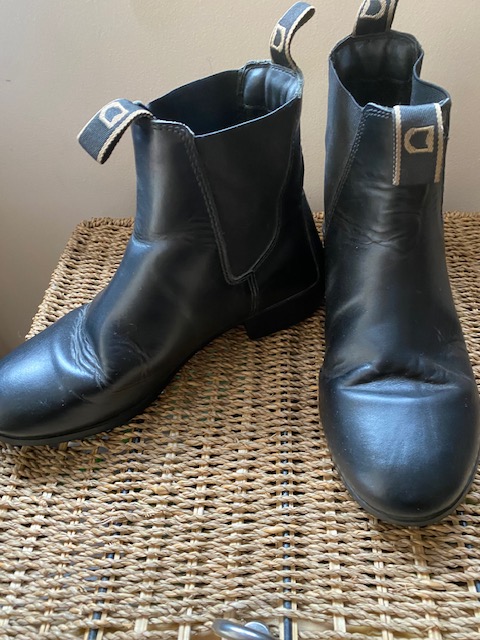
On the farm I always used short wellies! So, first pair of riding boots, second-hand, would do the job. These boots didn’t last too long, but that’s another blog. A few things to look for when buying riding boots.
Things to consider when buying:
Heel – essential to prevent your foot from slipping through the stirrup
Smooth sole – ensures the foot can easily slide out of the stirrup
Sturdy toe box – protects the toes
Height – depends on personal preference and wallet
Helmets
Equestrian Australia approved
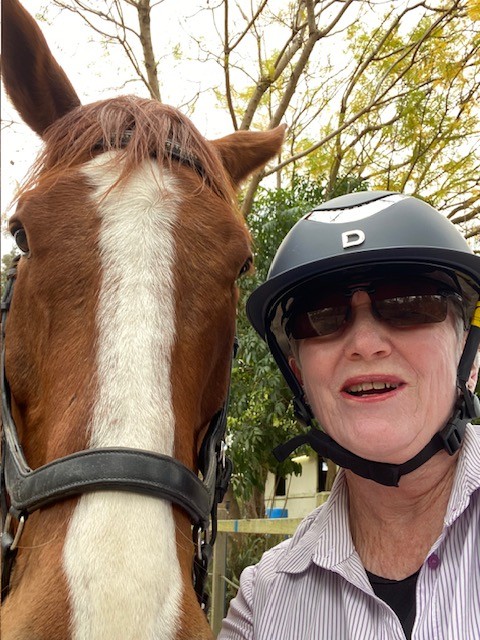
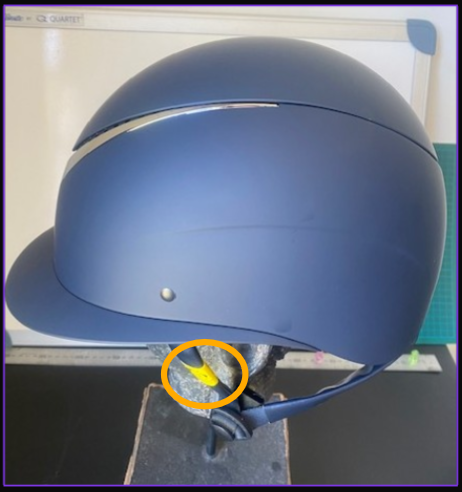
Having come from a cycling background, I’m very fussy about helmets. I never buy online, unless I have tried it on in real life (IRL), and am looking for a bargain. Same with riding helmets. I went to my local horsey shop and this Dublin helmet fit me like a kid glove.
Notice the fluro sticker on the strap. Helmets must meet current Equestrian Australia Safety Standards for Helmets and the sticker provides the evidence. Interested in reviewing the standards, click the link. https://bit.ly/48e60Pa
What to wear? The essentials!
Always want to look and feel good when on your freedom rides. For this first lesson I decided to take the low keyed approach. Foraging in the wardrobe revealed suitable attire.
Shirts
I have pasty, white skin that looks like vanilla blancmange, so it’s only long sleeved for me. From bushwalking I have a breathable shirt that fits the bill. Why breathable? Riding is hot work! I’ve since bought specific riding tops that are perfect.
Pants
Lesson #1, and up to #4, I wore a pair of stretchy jean like pants. Changed to riding breeches for improved grip and stability in the saddle. Also, stretchy, breathable fabric provides more flexible movement.
Knickers
Comfortable, and so not a G-String. Nasty things get wedged between the butt cheeks. OUCH! Can just imagine the chaffing.
Bras
Life has given me…well, let’s just say I’m a D cup. A supportive sports bra is a necessity. Don’t need bouncing bowling balls.
Other important stuff
There are a few other considerations before venturing into the arena.
Your basic everyday gardening gloves. I wore this type for nearly two years. They are the Cyclone Invisigrip type, and only $8.65 from your local Bunnings Warehouse (https://bit.ly/3Kw9KlX)
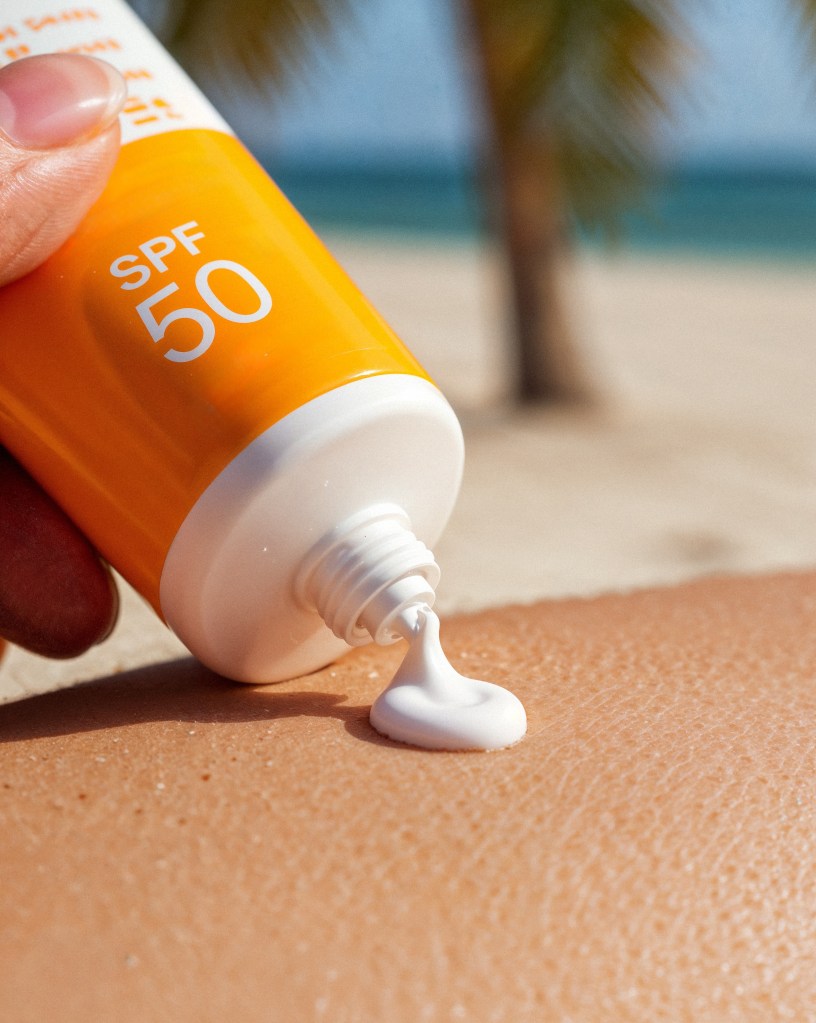
QUEENSLAND Australia! Beautiful all year round, but we’re not known as the SKIN CANCER CAPITAL OF THE WORLD for nothing. Dubious accolade, but it’s ours. Lifestyle is an outdoors’ affair, and I wouldn’t have it any other way. Yes, YES! There is the matter of my blancmange skin, but life would pass my by if I had decided to stay indoors.
A simple enough question from my partner of 30 years?? Also, not as straight forward, when your turning 67! That was two years ago and my fabulous partner LISTENED and that’s when I got back in the saddle.
Tell me, WHY?
WHY, you may ask? Everyone over the last two years has asked me that very question. I’m sure if the kitchen sink could talk, it’d toss in a few choice sudsy words, as well. Horse riding isn’t alien to me as I grew up on farms, but I have to admit you can count in decades (4 to be exact) not years since I had last ridden a horse. During those decades I have experienced different saddles in my life, as I’m an avid cyclist, but this saddle has stirrups and rests on the back of a horse.
Not a wee mini horse, oh no! An Off the Track Thoroughbred (OTT) standing at 17.1 hands high. HIs name is Valentino, but his stable name is Tino. He is a super special chestnut livin’ the life at the Wattle Creek Equestrian Centre (WCEC) Brisbane (Australia). The arenas are where my ‘back in the saddle’ journey takes place.
[A quick digression if you’re not hanging out at the stables. A “hand” is a unit of measurement for horses, equal to 4 inches, and is the horse’s height from the ground to the top of the withers (highest point of the shoulders). Check out the table below for conversions to imperial and metric measurements. Tino is the model.]
Height in hands
Inches
Centimetres (cm)
17.1
68.5
173.7
Perspective?
YES! The woman who has been diagnosed with osteopenia loves a challenge and horse riding fits the bill. Luckily heights don’t worry me, but a drop of approximately 174 cm without a safety net, well that is thought provoking. Anyway, there isn’t time to be worried about the height differential, because there are at least a thousand things to do – ALL AT ONCE.
Having grown up on farms, it was one of my chores (greatest loves) to bring in the cows for milking. This type of riding doesn’t require a ‘hindquarter yield’ or focus on ‘leg aids’, for me, it was more like windmilling. My term to describe the movement of arms and legs going where ever I desired. Funnily, stuck to the saddle like glue, but not pretty. Basically, I never received lessons, but always felt at home in the saddle.
Equine Aromatherapy – for me!
Arriving at WCEC for my first lesson in September 2023, memories came rushing back as the olfactory kicked into overdrive.
Others may not respond in a positive way to the smell of everything horse, but for me, I was home. To be truly honest, I craved equine aromatherapy. All horsey people know what I’m talking about. If I could bottle it, the world would be my oyster.
Those decades were not a quiet meander of work and looking forward to retirement to start living. They have been an adventure. My 50th birthday was monumentous as my partner and I rode the last week of the Tour de France. The iconic 21 hairpin turns of Alp d’Huez was a dream come true. Never too old!!
Adventures and challenges aplenty, onwards with the journey of my late sixties. Sit back and enjoy the ride! Sorry, sit with ear, shoulder, hip and heel in alignment.










 Back in the Saddle
Leave a comment